Comparison — Fibre Splitters
PLC vs FBT Splitter: Which One Does Your FTTH Network Need?
PLC vs FBT splitter: both split light from one fibre into many, but they are made differently and behave differently. Here is how to decide in a few minutes.
1x2 FBT 30/70 ₹549 + GST1x8 PLC ABS ₹1,899 + GSTFree delivery in Delhi NCR
- STEP 1FBT: fibres fused and stretched
- STEP 2PLC: waveguides on a chip
- STEP 3Light shared between outputs
- STEP 4Pick by ratio and wavelength
PLC vs FBT splitter comes down to how the fiber optic splitter is made: an FBT (fused biconical taper) splitter is made by fusing and stretching fibres together, while a PLC (planar lightwave circuit) splitter uses waveguides on a silica chip. Choose PLC for even splits above 1x4, for GPON and for wide wavelength use; choose FBT for low-cost 1x2 to 1x4 splits and for uneven ratios such as 30/70 or 10/90.
- PLC splitters share light evenly across roughly 1260–1650 nm, so one part works for GPON, XGS-PON and video overlays.
- FBT couplers are cheapest at small counts and can be made with uneven ratios, but their split shifts more with wavelength and temperature.
- Above about 1x4, PLC is usually smaller, more uniform and similar in price to a cascade of FBT couplers.
- Both are passive and need no power; both are sold bare, boxed or connectorised.
Updated:
How are FBT and PLC splitters made?
An FBT splitter is the older technology. Two or more fibres are twisted together, heated and pulled until their cores come close enough for light to cross from one to the other. By stopping the pull at the right moment, the maker sets how much light goes to each output. Larger counts are built by joining several couplers in a cascade.
A PLC splitter divides the optical signal into multiple outputs using semiconductor-style manufacturing. Waveguides are formed on a silica chip in a branching pattern, and fibre arrays are aligned and bonded to the input and output faces. Because the branching is drawn on the chip, a 1x32 is made by the same process as a 1x8. For the basics of how light travels in fibre, see our fiber optic guide.
PLC vs FBT splitter: side-by-side comparison
| Feature | PLC splitter | FBT splitter |
|---|---|---|
| How it is made | Waveguides on a silica chip | Fused and stretched fibres |
| Usual split counts | 1x2 to 1x64, and 2xN | 1x2 to 1x4 economically; more by cascading |
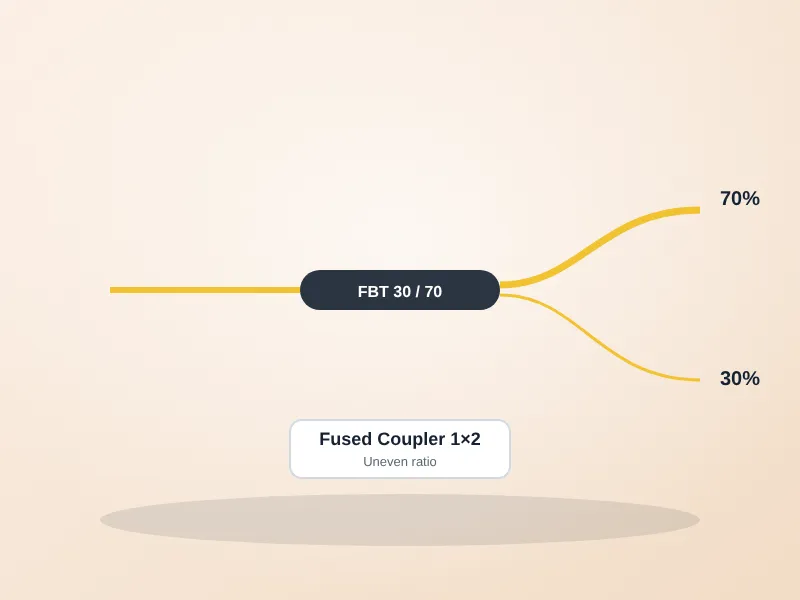
| Uneven ratios (e.g. 30/70) | Not usual | Yes, a main strength |
| Wavelength range | Broad, about 1260–1650 nm | Narrower windows, often 1310/1550 nm ± 40 nm |
| Uniformity between ports | Good, even at high counts | Falls as the count rises |
| Size at 1x16 and above | Compact | Bulky cascades |
| Cost | Higher at 1x2; competitive from about 1x8 | Lowest at 1x2 to 1x4 |
The table shows the pattern most planners follow: FBT for small or uneven taps, PLC for even distribution to many homes.
How do loss and uniformity compare?
For an even 1x2 split both types have an insertion loss of roughly 3.5 to 4 dB. The difference appears as the count rises. A cascade of FBT couplers adds the excess loss of every stage, and small differences in each coupler add up, so the best and worst output of a 1x16 FBT can differ by 2 dB or more. A 1x16 PLC splitter typically keeps its ports within about 1.2 dB of each other, with a maximum loss near 13.7 dB.
On a GPON network, the worst port sets the reach for every home on it, so poor uniformity effectively shrinks your power budget. That is why GPON designs almost always specify PLC splitters for 1x8 and above.
Why does wavelength matter?
GPON sends downstream at 1490 nm and upstream at 1310 nm, XGS-PON uses 1577 nm and 1270 nm, and cable-TV overlays use 1550 nm. A PLC splitter shares power almost equally over this whole range, so the same part supports today's service and a later upgrade.
An FBT coupler is tuned to particular operating windows. Outside them, its split ratio drifts, so one port may get noticeably more light than designed. This matters little on a single-wavelength link, but it can surprise a network that adds a new service on a different wavelength. Testing at two wavelengths with an OTDR or power meter quickly shows the difference.
When is an FBT splitter the right choice?
- Uneven taps on a chain. A road or village chain where each stop takes a small share and passes the rest on is a classic FBT job: for example a 10/90 tap near the source and a 30/70 tap further out.
- Monitoring. A 1/99 or 5/95 coupler lets a monitoring system watch a link while almost all the light carries on.
- Very low-cost 1x2 splits. For a single even split where wavelength is fixed, an FBT coupler costs less.
Mezux lists a 1x2 FBT coupler with a 30/70 ratio and SC/APC connectors for exactly these tapped designs.
When is a PLC splitter the right choice?
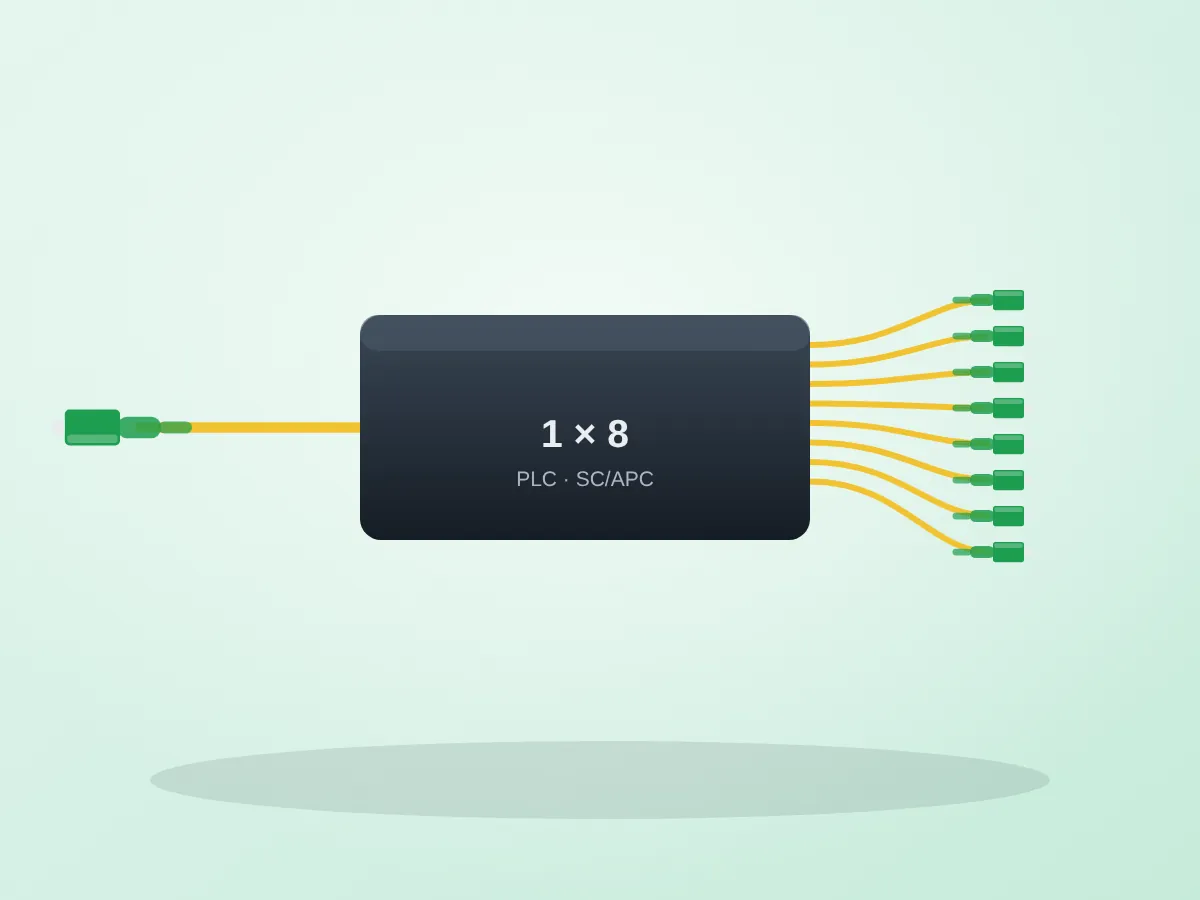
- FTTH and GPON distribution at 1x8, 1x16, 1x32 or 1x64.
- Networks that may add wavelengths, such as an XGS-PON upgrade or a video overlay.
- Tight spaces such as FAT boxes and closures, where a compact chip beats a cascade of couplers.
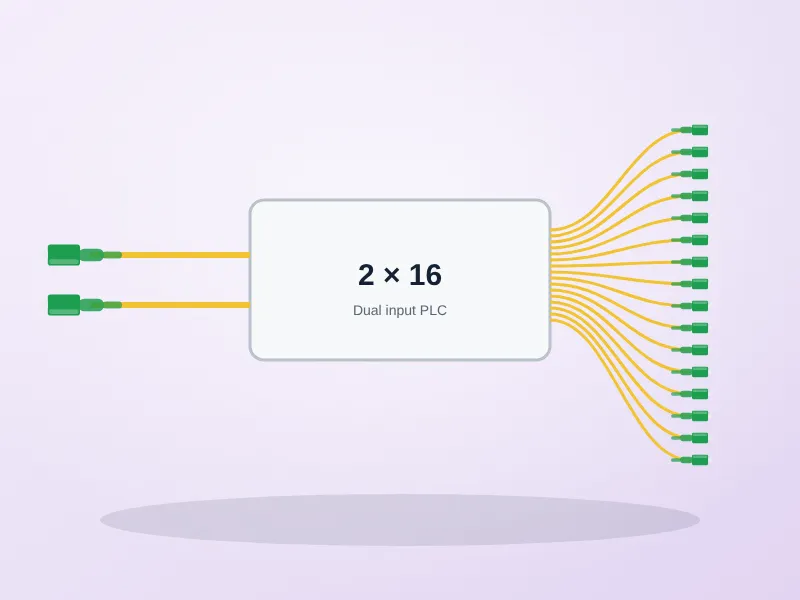
- Protected designs that need a 2xN splitter with two feeders.
For most ISPs the answer is simple: PLC for distribution, FBT only for special taps. Our PLC splitter buying guide covers split ratio, package and installation in detail, and the full range with prices is on the PLC splitters page.
How do temperature and reliability compare?
Outdoor boxes in India see anything from near-freezing winter nights in the north to well above 50 °C inside a metal cabinet in summer. PLC splitters are usually specified for −40 °C to +85 °C with little change in loss, because the chip is a single solid piece. FBT couplers are also built for outdoor use, but their split can drift a little more with temperature because it depends on the exact coupling length of the fused region.
In both types the weak points are usually the fibre leads and the connectors, not the splitting element. A well-sealed closure or FAT box, proper strain relief and clean connectors matter more for long service than the choice of technology.
Which applications suit each splitter type?
| Application | Better choice | Why |
|---|---|---|
| FTTH distribution, 1x8 to 1x64 | PLC | Even split, good uniformity, small size |
| GPON with a later XGS-PON upgrade | PLC | Flat response from 1260 to 1650 nm |
| Village or highway chain with taps | FBT | Uneven ratios such as 10/90 or 30/70 |
| Link monitoring tap | FBT | 1/99 or 5/95 ratios at low cost |
| Simple 1x2 on a single wavelength | Either | FBT is cheaper; PLC is more stable |
| Protected PON with two feeders | PLC (2xN) | Two inputs share every output |
How do you test either splitter on site?
The test method is the same for both technologies. Measure the light at the input with an optical power meter, then at each output, and compare the drop with the datasheet: about 3.5 to 4 dB for a 1x2, about 10.5 dB for a 1x8 and about 17 dB for a 1x32. A visual fault locator shows a broken lead immediately.
For an FBT coupler with an uneven ratio, check that the larger share leaves from the port marked for it; swapped leads are a common installation slip. For a PLC splitter, compare all ports – a single port far below the rest points to a damaged lead or a dirty connector rather than the chip.
What is the cost difference?
At 1x2 an FBT coupler is the cheaper part. From around 1x8 upward, a PLC splitter usually costs about the same as, or less than, the several FBT couplers needed to reach the same count, and it takes far less space. On the Mezux Store, the 1x2 FBT 30/70 coupler with SC/APC is listed at ₹549 + GST and the 1x8 PLC splitter in an ABS box with SC/APC at ₹1,899 + GST. Delivery is free in Delhi NCR; the rest of India is dispatched in one working day by courier, courier charge extra.
Sources
- Telcordia GR-1209-CORE – generic requirements for passive optical branching components (fused and planar types).
- ITU-T G.984.2 and G.9807.1 – GPON and XGS-PON wavelength plans and optical budgets.
- ITU-T G.671 – transmission characteristics of optical components.
- Mezux Store price list, 20 November 2026.
Saniya Parveen, Technical Content Lead – OFC & FTTH, Mezux Touch Pvt. Ltd. Saniya writes the Mezux Store buying guides, product pages and help pages on fibre cable, FTTH passives, splicing and testing. She works from the maker datasheets, the Mezux price list and notes from the company's OFC, HDD and splicing teams, which have worked on fibre routes across India since 2003. Spotted something that looks wrong? WhatsApp +91 99100 10209 with the page link.
More guides on fibre splitters and FTTH
Questions about PLC and FBT splitters
Is PLC always better than FBT?
No. PLC is better for even splits to many homes; FBT is better and cheaper for uneven taps and simple 1x2 splits.
Can I mix PLC and FBT in one network?
Yes. Many networks use FBT taps on a chain and PLC splitters at each distribution point. Just include each part's loss in the budget.
Do FBT splitters work with GPON?
They can on a fixed wavelength plan, but their split drifts with wavelength, so PLC is preferred for GPON distribution.
Which lasts longer?
Both are passive and long-lived when protected; quality of packaging and handling matters more than the technology.
Related store categories
Fibre route survey in Indian cities
- Fibre route survey in Delhi
- Mumbai OFC route scanning
- Bengaluru duct route survey
- Chennai fibre corridor survey
- Hyderabad OFC route check
- Kolkata fibre route survey
- Pune duct route scanning
- Ahmedabad OFC corridor survey
- Gurugram fibre route check
- Noida OFC route survey
- Jaipur duct route survey
- Lucknow fibre corridor scanning
Ask for a splitter quote
What to send for an exact quote
- Start and end points of the route, or a KML
- District and site type
- Survey type: standard or L-section
- When you want the crew on site
₹24/m · Min. order ₹50,000 — Delhi NCR (up to 2 km) · Min. order ₹1,00,000 — Rest of India (up to 4 km) · GST extra · 25–50% off above 100 km.
What happens next
- Scope check – we confirm route length, crossings and L-section need.
- Written quote – rate, slab, minimums, extras and a day-by-day programme.
- Mobilisation – our own crew and systems on the agreed date.


