Buying guide — PLC Splitter
A Complete Guide on How to Choose a PLC Splitter and Installation Tips
How to choose a PLC splitter in four decisions – split ratio, loss, package and connector – and how to fit it so every home on the PON keeps enough light.
1x8 ABS SC/APC ₹1,899 + GST1x16 ABS ₹2,999 + GSTFree delivery in Delhi NCR
- STEP 1Light enters the input port
- STEP 2Chip waveguide branches it
- STEP 3Equal power reaches each port
- STEP 4Every home gets its share
A PLC splitter is a passive fiber optic component: a chip that divides the light in one fibre equally among 2 to 64 outputs. To choose one, start with the number of homes each fibre must serve, check that the split loss fits your GPON power budget, then pick the package (bare tube, ABS box, cassette or rack) and the connector your network already uses, usually SC/APC.
- Every doubling of the split ratio costs about 3 to 3.5 dB of extra loss: a 1x8 is near 10.5 dB, a 1x16 near 13.7 dB and a 1x32 near 17 dB.
- A GPON class B+ link allows 28 dB between OLT and ONT, so the splitters, fibre, splices and connectors together must stay inside it.
- The package follows the place: bare steel tube inside closures, ABS box in FAT boxes, LGX cassette or 1U rack in the OLT room.
- Match the polish everywhere – green SC/APC for FTTH – and keep every connector clean; dirty end faces cause many field faults.
Updated:
What is a PLC splitter and how does it work?
PLC stands for planar lightwave circuit. Inside every PLC splitter is a small silica chip with waveguides etched on it, branching like a tree: one input splits into two, each of those into two again, and so on until there are 4, 8, 16, 32 or 64 outputs. Fibre arrays are bonded to both ends of the chip, and the whole assembly is protected in a steel tube, a plastic box or a rack panel.
Because the light is divided by the chip itself, a PLC splitter is passive – it needs no power – and it shares light almost equally between all outputs across the wavelengths used by GPON, XGS-PON and video overlays (roughly 1260 nm to 1650 nm). That is the main reason operators use PLC rather than older fused couplers for any split above 1x4. If you are still deciding between the two technologies, our PLC vs FBT splitter comparison sets out where each one fits.
Which split ratio do you need?
The split ratio is the first decision and it comes from the network plan, not from the price list. Count how many subscribers one feeder fibre has to serve and how the split will be staged:
- Single-stage (centralised) – one 1x32 or 1x64 splitter at the OLT room or a street cabinet serves every home directly. It keeps splitters in one secure place but uses more distribution fibre.
- Two-stage (cascaded) – for example a 1x4 at the cabinet feeding 1x8 splitters in FAT boxes, giving 1x32 overall. This is a very common design in Indian FTTH because it saves fibre in lanes and colonies.
- Dual-input (2xN) – a 2x16 or 2x32 splitter takes a second feeder from another route, so a fibre cut on one side does not take every customer down.
Leave room for growth. A 1x8 in a FAT box that already serves eight homes cannot take a ninth, so many ISPs place 1x16 boxes in dense lanes and 1x8 boxes in spread-out areas.
How much loss does a PLC splitter add?
Every split halves the light, which is about 3 dB, plus a small excess loss from the chip and the fibre joints. Published industry specifications give these typical maximum figures for good-quality PLC splitters, excluding connector loss:
| Split ratio | Typical max insertion loss | Typical uniformity |
|---|---|---|
| 1x2 | about 4.0 dB | 0.4 dB |
| 1x4 | about 7.3 dB | 0.6 dB |
| 1x8 | about 10.5 dB | 0.8 dB |
| 1x16 | about 13.7 dB | 1.2 dB |
| 1x32 | about 17.0 dB | 1.5 dB |
| 1x64 | about 20.5 dB | 2.0 dB |
Uniformity is the difference between the best and the worst output port; a low figure means every home gets nearly the same light. Always read the test sheet supplied with the batch, because values vary slightly between makers. Return loss (typically 50 dB or more for UPC and 55 dB or more for APC) and polarisation dependent loss (usually under 0.3 dB) matter less for buying decisions but should be on the datasheet too.
How do you check the GPON power budget?
A GPON link has a fixed optical budget set by the OLT and ONT optics: class B+ allows 28 dB and class C+ allows 32 dB between the OLT and the farthest ONT. Add up everything on the path:
- Splitter loss – for example 7.3 dB for a 1x4 plus 10.5 dB for a 1x8 in a two-stage 1x32 design.
- Fibre loss – roughly 0.35 dB per km at 1310 nm on G.652D single-mode fibre.
- Splices – about 0.1 dB each for a good fusion splice.
- Connectors – about 0.3 to 0.5 dB per mated pair.
- A safety margin of 2 to 3 dB for ageing, repairs and dirty connectors.
For a 1x32 two-stage design with 8 km of fibre, 6 splices and 6 connector pairs, the total is about 17.8 + 2.8 + 0.6 + 2.4 = 23.6 dB, which leaves a healthy margin inside a 28 dB class B+ budget. A single-stage 1x64 at the same distance would come much closer to the limit. If the sum is tight, choose a smaller split, shorten the route or use higher-class optics.
Which splitter package fits where?
The same chip is sold in several packages, and the right one depends on where the splitter will sit:
| Package | Where it goes | How it is joined |
|---|---|---|
| Bare / mini steel tube | Inside joint closures and splice trays | Fusion spliced |
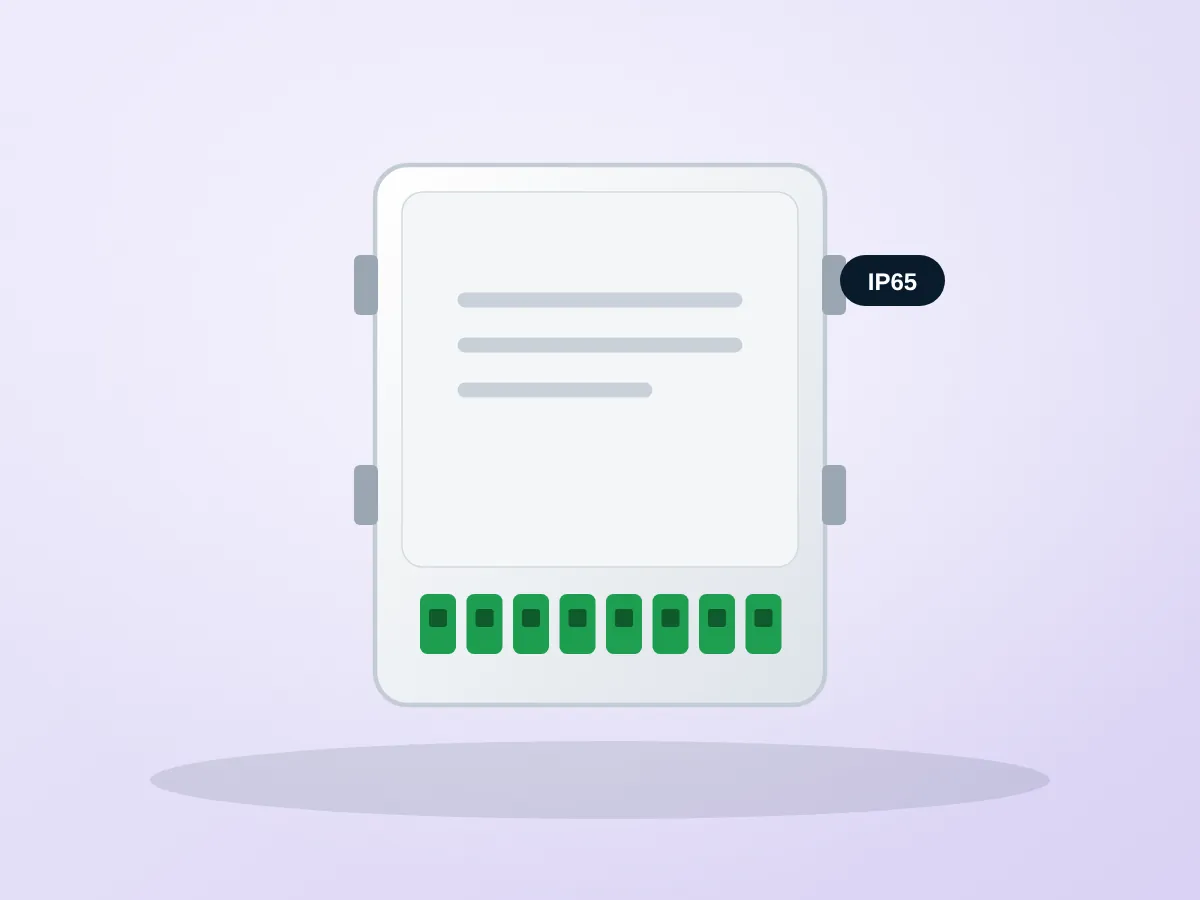
| ABS box | FAT boxes, wall boxes, distribution points | Connectorised leads, patched |
| LGX / cassette | Chassis in cabinets and ODFs | Front adapters, patched |
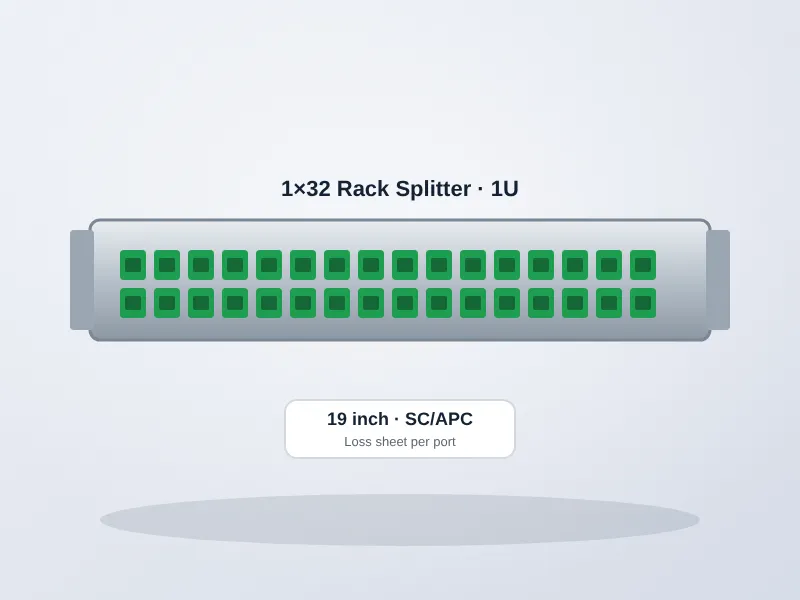
| Rack-mount 1U | OLT room, exchange, data room | Front adapters, patched |
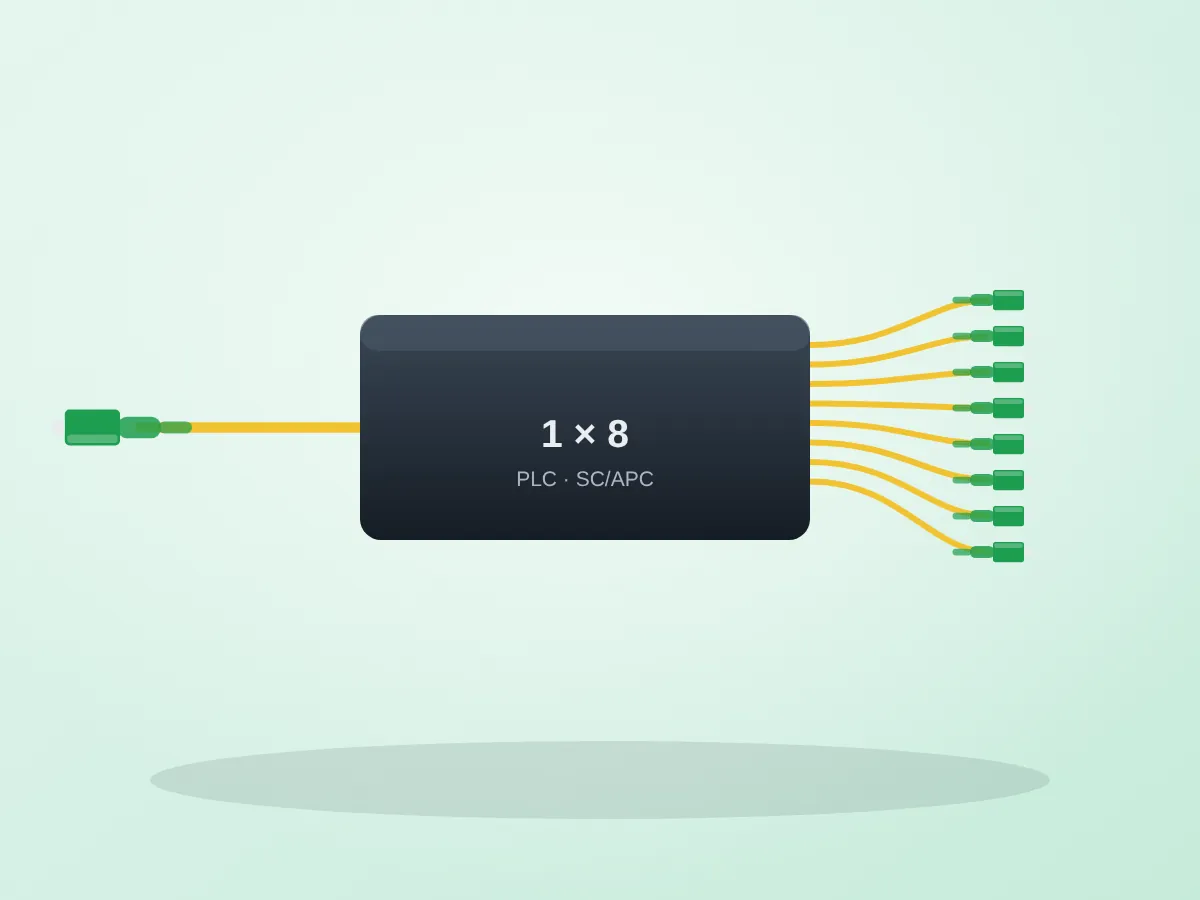
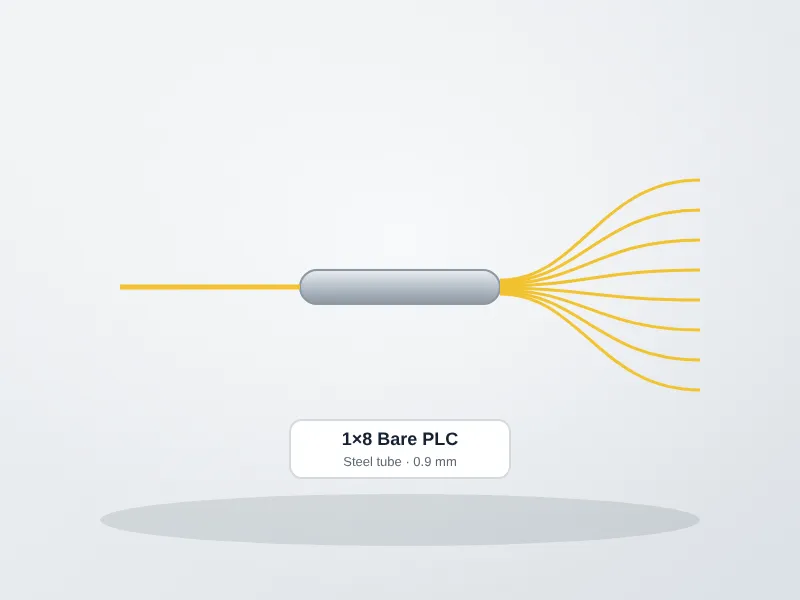
Bare splitters are cheapest and smallest but need a splicer for every change. Connectorised ABS box splitters cost more yet let a field technician connect or move a home in minutes. Mezux lists the 1x8 PLC splitter in an ABS box with SC/APC, a bare steel-tube 1x8, a 1x16 ABS box and a 1x32 rack-mount unit, so each place in the network has a matching part.
What types of PLC splitter can you buy?
Makers sell the same chip in several types, named after the way the fibres leave the package. Knowing the names helps when you compare quotes:
- Bare fiber splitter – the chip in a small steel tube with 250 µm bare fibre leads. It is the smallest type and is spliced inside trays.
- Blockless or mini-module splitter – a steel tube with 0.9 mm buffered leads, tougher to handle in the field than bare fiber leads.
- Mezux lists this type as its 1x8 bare steel-tube splitter.
- ABS box splitter – a plastic module with 2 mm or 3 mm leads ending in connectors, made for FAT and distribution boxes.
- LGX or plug-in cassette – a metal cassette with adapters on the front that slides into a chassis, common in street cabinets.
- Rack-mount splitter – a 19-inch, 1U or 2U panel for central offices, exchanges and OLT rooms.
- Tray type – a splitter on its own splice tray, for closures that take standard trays.
The chip performance is the same for a given split ratio; connectorised types add about 0.3 dB per connector. Beyond that you pay for the protection, the connectors and the handling convenience.
Central offices or cascaded splitting – which suits your network?
Split ratios also depend on where the splitting happens. In centralised deployments, all splitting is done at the central office or a single cabinet, so every home has its own fibre back to that point. It makes faults easy to isolate and ports easy to reassign, but it needs far more fibre in the street.
In cascaded deployments, splitting happens in two places: a small split near the OLT and a second split close to the homes. It needs fewer fibres and suits Indian lanes and colonies, where laying many cables is hard. Whichever you choose, keep the total split within your power budget and keep a record of which splitter port serves which customer.
Which connector and polish should you choose?
Most FTTH and GPON networks in India use SC/APC connectors, recognisable by their green housing. The 8-degree angled end face reflects very little light back towards the OLT, which matters on PON and on RF video overlays. Data-centre and enterprise links more often use blue SC/UPC or LC/UPC connectors.
Never mix the two: an APC plug mated with a UPC port leaves an air gap, adds high loss and can scratch both end faces. Pick the splitter connector to match the adapters in your FAT boxes and ODFs, and buy SC/APC patch cords to the same standard. If a feeder arrives as bare fibre, an SC/APC pigtail set gives it a factory connector after one fusion splice.
How do you install a PLC splitter so it lasts?
Good splitters still fail in the field when they are fitted carelessly. These habits prevent most problems:
- Keep caps on until the last moment. Dust on a ferrule is a common cause of high loss on new connections. Clean every connector with a click cleaner before mating.
- Respect the bend radius. Route the short fibre leads around the guides in the box; a tight loop behind a lid can add several dB of loss, especially at 1550 nm.
- Fix the module firmly. Seat the ABS box in the splitter slot of the FAT box so it cannot move when the door is opened.
- Label every output. Write the house or flat number against each port and on the drop cable, so a repair team can trace a fault without testing every line.
- Measure before you leave. Check the light level at the far end with an optical power meter and record it; it becomes the baseline for every future complaint.
What mistakes should you avoid when buying splitters?
- Buying on price alone. A cheaper splitter with poor uniformity can cost more in truck rolls than it saves.
- Ignoring the wavelength range. If you plan XGS-PON or a video overlay, check that the datasheet covers the full 1260–1650 nm band. A fused biconical taper (FBT) coupler covers narrower windows.
- Mixing connector types. One batch with UPC connectors in an APC network creates faults that are hard to trace.
- Skipping the test sheet. Ask for port-by-port insertion loss and keep it with the network records.
When you ask for a quote, send the split ratio, the package type, the connector and polish, the lead length and the quantity. That is enough for an exact price.
What does a PLC splitter cost in India?
Price depends on the split ratio, the package and the connectors more than on the chip. On the Mezux Store, a bare 1x8 steel-tube splitter is listed at ₹349 + GST, the 1x8 ABS box with SC/APC on every port at ₹1,899 + GST, a 1x16 ABS box at ₹2,999 + GST and a 1x32 rack-mount unit at ₹6,999 + GST, with 5% off at 10–49 units and 10% off at 50 or more. Delhi NCR orders are delivered free; the rest of India is dispatched within one working day by courier, courier charge extra. See every model with its rate on the PLC splitters page.
Sources
- Telcordia GR-1209-CORE and GR-1221-CORE – generic requirements and reliability for passive optical branching components.
- ITU-T G.984.2 – GPON physical layer, including class B+ (28 dB) and C+ (32 dB) optical budgets.
- ITU-T G.671 – transmission characteristics of optical components and subsystems.
- ITU-T G.652 and G.657 – single-mode fibre characteristics used for the fibre-loss figures.
- Mezux Store price list, 20 November 2026.
Saniya Parveen, Technical Content Lead – OFC & FTTH, Mezux Touch Pvt. Ltd. Saniya writes the Mezux Store buying guides, product pages and help pages on fibre cable, FTTH passives, splicing and testing. She works from the maker datasheets, the Mezux price list and notes from the company's OFC, HDD and splicing teams, which have worked on fibre routes across India since 2003. Spotted something that looks wrong? WhatsApp +91 99100 10209 with the page link.
More guides on fibre splitters and FTTH
Questions about choosing a PLC splitter
Which split ratio is most common in Indian FTTH?
A two-stage design with 1x8 splitters in FAT boxes, fed by a 1x4 or 1x8 at the cabinet, is very common. It gives 1x32 or 1x64 overall while keeping drops short.
Does a PLC splitter need power?
No. It is a passive glass chip and works without electricity, which is why it can sit in a sealed box on a pole.
Can I use a 1x16 where I planned a 1x8?
Only if the power budget still works: a 1x16 adds about 3 dB more loss than a 1x8. Check the farthest home first.
How long does a PLC splitter last?
Splitters built to Telcordia reliability requirements are designed for many years of outdoor service; most failures come from damaged leads or dirty connectors, not the chip.
Related store categories
Fibre route survey in Indian cities
- Fibre route survey in Delhi
- Mumbai OFC route scanning
- Bengaluru duct route survey
- Chennai fibre corridor survey
- Hyderabad OFC route check
- Kolkata fibre route survey
- Pune duct route scanning
- Ahmedabad OFC corridor survey
- Gurugram fibre route check
- Noida OFC route survey
- Jaipur duct route survey
- Lucknow fibre corridor scanning
Ask for a splitter quote
What to send for an exact quote
- Start and end points of the route, or a KML
- District and site type
- Survey type: standard or L-section
- When you want the crew on site
₹24/m · Min. order ₹50,000 — Delhi NCR (up to 2 km) · Min. order ₹1,00,000 — Rest of India (up to 4 km) · GST extra · 25–50% off above 100 km.
What happens next
- Scope check – we confirm route length, crossings and L-section need.
- Written quote – rate, slab, minimums, extras and a day-by-day programme.
- Mobilisation – our own crew and systems on the agreed date.


